

The land of Pennsylvania was inhabited by Native American tribes long before the first Europeans arrived. These tribes included the Shawnee, the Susquehannock, the Iriquois, the Oneida, and the Seneca nations.
Europeans began exploring the region in the early 1600s. The British took control of the area in 1664 and, in1681, a man named William Penn given a huge area of land by King Charles II of England. He named the land Pennsylvania after his family name “Penn” and after the forests in the land (“sylvania is “forest land” in Latin).
William Penn wanted his colony to be a place of religious freedom so it was no surprise that some of the first settlers were people called Quakers looking for a place where they could practice their religion without persecution. Throughout the early 1700s more people from Europe immigrated to Pennsylvania. Many of them came from Germany and Ireland.
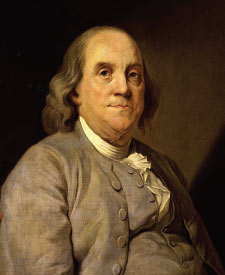
When the American Colonies decided to fight for their independence during the American Revolution, Pennsylvania was at the center of the action. And, one of the most prominent Founding Fathers was Pennsylvanian Ben Franklin (pictured here).
Philadelphia, Pennsylvania: A Historic City
Philadelphia is the biggest city in Pennsylvania and one of the most historic cities in the United States of America. During the American Revolutionary War, Philadelphia became the site of the First and Second Continental Congresses. And after the federal and state governments left Philadelphia, the city remained the cultural and financial center of the country.
The Declaration of Independence was signed in Philadelphia. Philadelphia is also the home of the famous American symbol of freedom: the Liberty Bell. Philadelphia is home to Independence Hall, the Ben Franklin Museum, and the Betsy Ross House.
Other Notable Cities in Pennsylvania
- Pittsburgh is the second-largest city in Pennsylvania.
- Harrisburg is the capital of Pennsylvania.
- State College, Pennsylvania is the home of Pennsylvania State University. The area around Penn State is known as Happy Valley. On home football Saturdays, Happy Valley becomes the third-largest city in Pennsylvania

Fact #1: Philadelphia, is called “The City of Brotherly Love.”
Fact #2: Pennsylvania ratified the the U.S. Constitution in 1787 and become the 2nd state.
Fact #3: Hershey, Pennsylvania is called Chocolate Town, USA because that’s where they make Hershey’s candies.
Fact #4: Latrobe, Pennsylvania is home to not one but two famous Americans: Arnold Palmer, a golfing legend, and Fred Rogers, the creator of Mr. Rogers Neighborhood, a popular television show for children.
Fact #5: With the help of Philadelphia’s most famous resident, Benjamin Franklin, the first hospital in America was founded in 1751.
Fact #6: Pennsylvania’s nickname is “The Keystone State.” Pennsylvania’s essential role in the founding of the United States earned the nickname. The term “keystone” comes from architecture and refers to the central, wedge-shaped stone in an arch that holds all the other stones in place. Pennsylvania was so important to the new nation that it was considered the keystone that held the 13 colonies together.

Just for fun, see if you can answer these questions.
What is the capital of Pennsylvania? Is it Philadelphia, Pittsburg, Hershey, or Harrisburg?
Harrisburg is the capital of Pennsylvania.
Which Pennsylvania town is famous for its chocolates?
Hershey, Pennsylvania.
Was Fred Rogers from Philadelphia, Pittsburg, Latrobe, or Hershey?
Mr. Rogers was from Latrobe, Pennsylvania. So was the champion golfer Arnold Palmer.
Is Philadelphia called "The City of Brotherly Love," "The City That Never Sleeps," or "The Windy City?"
Philadelphia is called “The City of Brotherly Love.”
New York is called “The City That Never Sleeps,” and Chicago, Illinois is called “The Windy City.”

If you have time, you can write a story of your own.
Here are a couple of story ideas you can choose from.
Idea #1: You can write a brief story about some of the cool things you learned about Philadelphia and the Commonwealth of Pennsylvania.
Or
Idea #2: If you could talk to Ben Franklin, what questions would you ask? And, how do you think he would answer?
To help you write a great story, we have some helpful hints and timely tips.
Check out “10 Tips for Writing Better Essays.”
Here's a riddle for you:
What is the world's longest punctuation mark?
The hundred-yard dash.

For fun-to-read books about a girl detective who homeschools on a train... check out The Mystery Ryders, a series from the creators of the Homeschool Express.
